How to Choose a Log Saw Belt for Tissue Processing Equipment? A Comprehensive Analysis of Valmet Tissue Log Saw Belt Applications
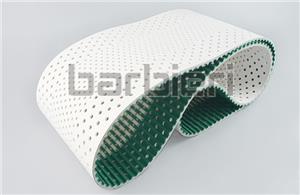
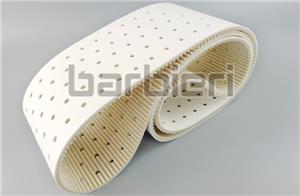
The ideal conveying component for tissue log saw equipment is the PU timing belt with an integrated guide track. Barbieri’s Log Saw Belts for the Tissue Industry feature a structure combining an integrally molded guide track with a high-strength steel cord core. Widely compatible with Valmet tissue log saws, parent roll saws, and toilet paper log cutters, these belts effectively address three major industry pain points: belt tracking issues (wandering), guide track detachment, and inconsistent cutting lengths.
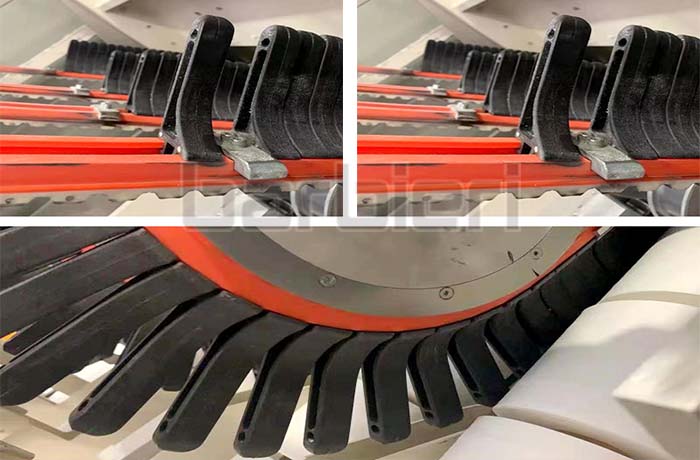
What is a log saw belt for tissue processing equipment?
The log saw belt is a critical drive and conveying component in the downstream cutting line of tissue production. Installed on the log saw, it grips and conveys cylindrical parent paper rolls (logs), feeding them into the cutting station at a precise, constant speed.
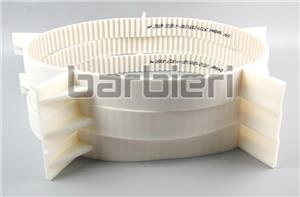
Typically, multiple sets of timing belts are arranged in pairs and driven in coordination; they securely grip the paper log from both sides to ensure uniform cutting dimensions for every roll. Issues such as belt wandering, slippage, or wear directly lead to inconsistent cutting lengths, increased scrap rates, and even production line downtime.
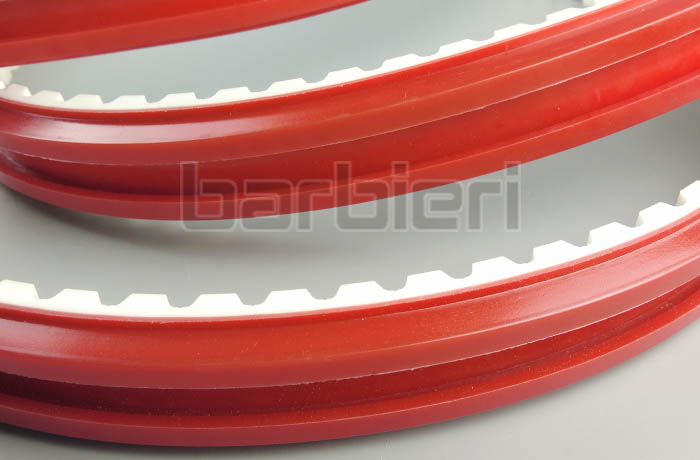
Barbieri Tissue Processing Log Saw Timing Belt:
Item | Specifications / Description |
Product Name | Log Saw Belts for the Tissue Industry (Custom PU timing belts with integrated guide grooves) |
Brand | Barbieri |
Main Material | High-quality polyurethane (TPU) with an embedded high-strength steel cord tension member |
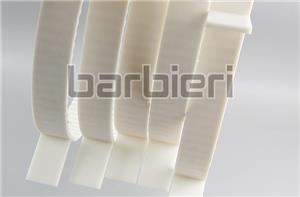
Guide Channel Structure | Integrated molding with the belt body (not bonded post-production) |
Guide Channel Color | Available in red or white PU |
Compatible Equipment | Valmet Tissue Log Saw, parent roll saws, toilet paper log cutters, etc. |
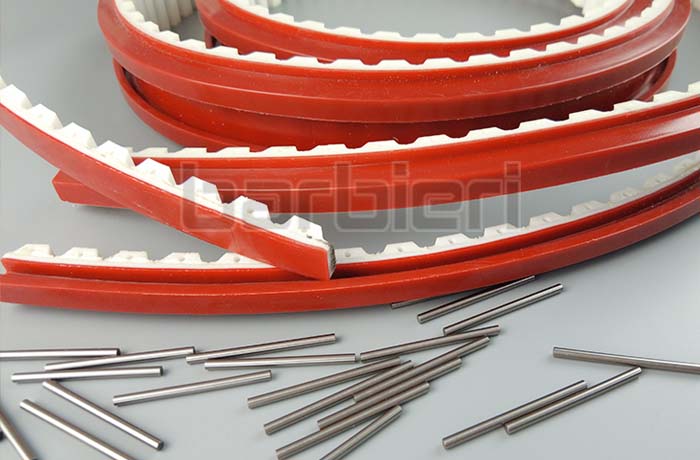
Customization Scope | Belt circumference, width, guide groove dimensions, pin-spliced belt |
Key features of the PU timing belt with integrated guide track:
1. Integrally molded guide track structure eliminates delamination risks
The guide track is molded as a single unit with the timing belt body, ensuring high bond strength and structural stability. This fundamentally minimizes the risk of the guide track detaching, cracking, or delaminating. It offers high guiding precision and smooth operation, reducing feeding stutters and localized uneven wear.
2. Smooth guide track surface free of burrs
Precision-machined for a flat, smooth surface, the guide track minimizes abnormal friction during high-speed equipment operation. This prevents feeding stutters and transmission instability caused by manufacturing defects in the guide track.
3. Cut and Tear-Resistant TPU Material
Log sawing operations involve high levels of paper dust, continuous friction, and high mechanical stress. The high-quality TPU base material offers excellent resistance to cutting, tearing, abrasion, and impact, significantly extending the belt's service life.
4. High-Precision Synchronous Feeding for Consistent Cut Lengths
The steel-cord reinforced polyurethane base material features low elongation, ensuring tight tooth meshing and zero-slip power transmission. Synchronized drive systems ensure uniform feeding speed for the parent paper logs, guaranteeing consistent cut dimensions for every roll and reducing the scrap rate.
5. Wear-Resistant Cushioning for Stable High-Speed Operation
The red rubber layer offers excellent toughness, wear resistance, and vibration damping. It ensures smooth conveyance during continuous high-speed operation, minimizing the impact of vibration on cutting precision.
6. Excellent Flex Fatigue Resistance
The TPU body withstands repeated bending and resists cracking during prolonged, uninterrupted production, thereby reducing downtime associated with belt replacement.
Application Scenarios
● Valmet Tissue Log Saw cutting stations
● Parent roll saws: Downstream tissue cutting lines
● Toilet paper log cutters: Rewinding and log-cutting processes
Suitable for high-speed, continuous sawing of large tissue logs; helps enhance the operational stability of the entire tissue cutting line and reduces the risk of maintenance-related downtime.
FAQ
Q1: What causes belt tracking issues (lateral drift) on log saws, and how can this be resolved?
Lateral drift is often caused by a loose connection between the guide track and the belt body or by surface defects on the guide track. Barbieri guide-track PU synchronous belts feature an integrated guide track structure that provides precise lateral guidance, preventing drift at the source.
Q2: Can the Valmet Tissue Log Saw use a custom-made domestic belt?
Yes, it can. Barbieri offers custom specifications for belt circumference, width, and guide groove dimensions, as well as pin-jointed endless belts, providing tailored solutions for Valmet Tissue Log Saws and other log saw models.
Q3: What is the difference between the red and white guide grooves?
Both are made of PU and offer identical performance; the primary difference is color coding, allowing users to select the version best suited to their equipment assembly and production environment.
Q4: How can I order a custom log saw timing belt? What parameters are required?
You need to provide details such as the equipment model, belt circumference, belt width, guide groove dimensions, and the desired joining method; the manufacturer will then produce a custom belt based on these specifications.
Summary
For manufacturers of tissue and sanitary paper products, the stability of log saw belts directly impacts cutting precision and production line efficiency. Barbieri’s guide-groove PU timing belts—featuring integrally molded guide grooves, cut-resistant TPU material, and high-precision synchronous feeding—are widely compatible with mainstream equipment like Valmet Tissue Log Saws. They offer a reliable solution to issues such as belt mistracking, guide groove detachment, and inconsistent cutting, while also providing on-demand customization for circumference, width, and guide groove dimensions.