How much clearance is appropriate between a timing belt and a timing pulley? Matching width method for timing belts and pulleys
In conventional designs, the timing belt is narrower than the timing pulley. The standard selection principle is that the effective tooth width of the timing pulley is slightly larger than the width of the timing belt. First, calculate the required timing belt width based on the load torque (including the safety factor), then determine the clearance based on the type of timing pulley flanges. The timing pulley should not be widened indefinitely. Properly matching the timing pulley tooth width can prevent side friction damage during timing belt operation and control the overall machine space and processing costs.
Width allowance can be reserved according to the timing pulley flange type:
Double-flange timing pulley: With a double-sided limiting structure, the timing belt operation is stably limited with minimal offset. Small clearance requirement. The timing pulley tooth width is 1-2mm wider than the timing belt width. Suitable for most conventional precision transmission equipment.
Non-flange timing pulley: Without side limiting constraints, the timing belt has a higher degree of freedom of operation, but is prone to small offsets. A larger safety clearance is required. The timing pulley tooth width is 2-5mm wider than the timing belt width to buffer the offset and reduce the risk of belt slippage.
Low-speed conveying scenarios: For low-speed conveying conditions without high-precision positioning, a 3-10mm allowance for the timing pulley tooth width is sufficient to meet the basic operational requirements of the equipment.
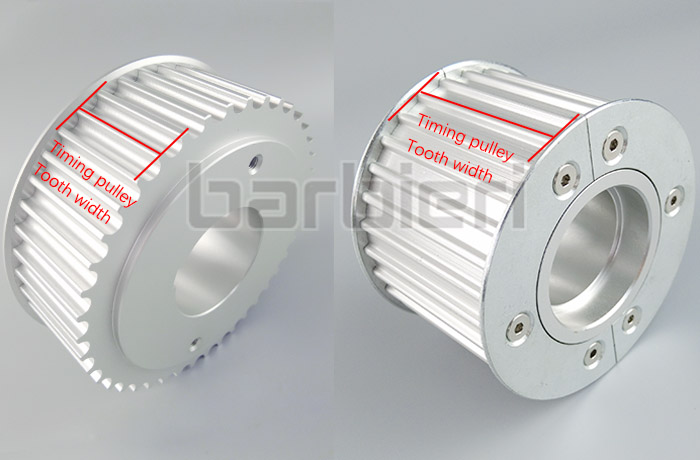
The allowance range for the width of the timing belt and timing pulley is not a universal fixed value. The upper and lower limits must be flexibly selected based on the equipment's operating conditions. For high-speed, heavy-load conditions, select the upper limit of the clearance; for precision, light-load, high-precision positioning conditions, select the lower limit of the clearance. Strict control of lateral movement of the timing belt is crucial to ensure transmission accuracy and equipment stability.
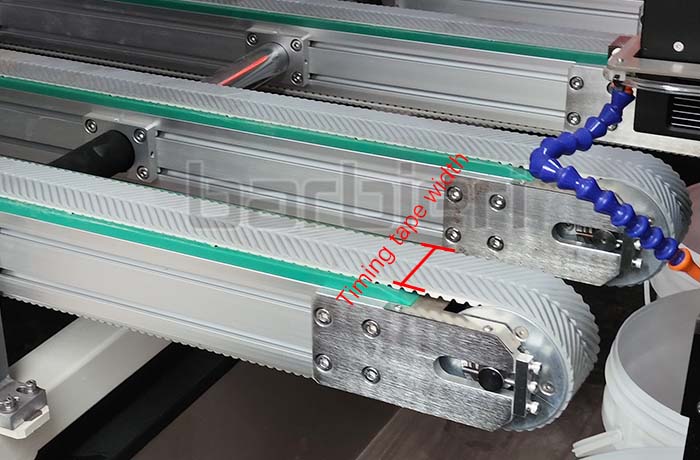
For example: This timing belt conveyor uses a 60mm wide timing belt with a matching 62mm timing pulley tooth width.
Avoiding common timing belt drive faults:
1. Timing belt width > Timing pulley tooth width: During operation, the side of the timing belt continuously rubs against the retaining edge, which can easily lead to edge chipping, belt cracking, and belt breakage over long-term use.
2. Timing belt width = Timing pulley tooth width: Due to the processing and assembly tolerances of the timing belt and pulley, even slight misalignment will cause the belt side to rub tightly against the retaining edge, resulting in wear and damage to the belt side over long-term operation.
3. Excessive clearance allowance of the synchronous pulley: The lateral limit of the synchronous belt fails, and the synchronous belt frequently shifts left and right during operation, resulting in decreased transmission accuracy, equipment vibration and abnormal noise, abnormal wear of belt teeth, and seriously affecting the stability of the transmission system.